45W quads and tri-cores, 3GHz duals
Several 45nm Athlons have popped up on price search engines. Although we already talked about most of them, we've got a few more specs this time around, although we still don't have any prices.
Let's start off with the new flagship quad-core Athlons, based on the Propus core with no L3 cache. Two models have popped up, the Athlon II X4 605e and 600e. Both feature 4x512kb of L2 cache, HT up to 4.0GB/s, and dual-channel DDR3 1333 memory support. The 605e runs at 2.3GHz, while the 600e is clocked at 2.2GHz. Bear in mind that these are "e" series power efficient parts, and the TDP is an impressive 45W, a first for desktop quad-cores.
Moving on to tri-core, Rana-based CPUs, we can see two models, the 400e and 405e. They are clocked at 2.2GHz and 2.3GHz respectively. The rest of the spec is similar to that of the 6xxe series, minus one core.
And for the first time AMD has gone 45nm with its dual cores. The Athlon II X2 250 and 245 are Regor-based. They are clocked at 3.0GHz and 2.9GHz respectively. Unlike the new quad and tri-core parts, these are not power efficient models, and the TDP is rated at 65W, which is still adequate.
thanks : fudzilla.com
Saturday, May 09, 2009

XFX HD 4890 Black Edition 1GHz available
At first for registered Black Edition fans
It looks like XFX managed to get ahead in the Radeon HD 4890 at 1GHz race, as we’ve learned that these cards have entered the mass production.
The first quantity of just fewer than 100 cards was produced last week, and it should be available shortly in the Euro region at €259. The price will depend on the exchange rate and the country. The first batch will be limited to Black Edition-registered users only and after the second batch arrives, it will be available for the global market.
The second batch of more cards is expected in the next two weeks and the card will launch covered with Black edition brand.
Our sources also imply that the Black edition HD 4890 at 1GHz will also feature HAWX DirectX 10.1 game in the box as well as local priority Black Edition support. This might be first 1GHz card available.
credit : fudzilla.com
AMD had 19.8% of EMEA desktop share in Q1
According to the fresh information from IDC, in the EMEA market AMD scored 19.8 percent of total desktop market in Q1 2009. Intel grew its market share to 80.2 percent.
A year before in Q1 2008 AMD had 23.7 percent, while Intel had 76.2 percent of the desktop market share, and others had 0.2 percent of market share and AMD managed to drop down to 20.7 percent in Q4 2008 while Intel grew to 79.3 percent.
The picture is still quite pretty when it comes to desktop CPUs and in mobile CPUs Intel has more than 90 percent of the market. At least in EMEA AMD didn’t do that well and it didn’t managed to grow the market in Europe but it didn’t lose the market share drastically, just 0.9 percent from Q4 2008, while Intel gained just as much.
Credit : fudzilla.com
Friday, May 08, 2009
The Core 2 Quad Q8400 VS Phenom II 940
Q8400 quad-core chip running at 2.66GHz with a 2MB L2 per pair of cores (4MB total). It’s like two Pentium Dual Core processors on a single package.
These chips actually have a 6MB L2 but with 2MB disabled either because they have irrecoverable defects in the cache or simply to hit the right price point. In other words, the Q8400 is literally a Q9400 but with 2MB of its L2 disabled.


Source : Anandtech.com
These chips actually have a 6MB L2 but with 2MB disabled either because they have irrecoverable defects in the cache or simply to hit the right price point. In other words, the Q8400 is literally a Q9400 but with 2MB of its L2 disabled.


Source : Anandtech.com
AMD Phenom II -Record Overclock by Air, Dry Ice, LN2
Overclocker Chew* relentlessly overclocks "Dragon Technology" with stock AMD Phenom II X4 955 on air, phase, dry ice, and liquid nitrogen. See record 3DMark06 performance for dual ATI Crossfire with ATI Radeon HD 4850 and 4890 GPU, Gigabyte motherboards and OCZ memory. Proving Grounds.
Wednesday, May 06, 2009
PC processors poised for growth
PC processor makers have sold off "most of not all" their excess inventory that piled up due to the recession creating "the potential for positive growth" in the next three to six months, according to an upcoming report from Mercury Research (Cave Creek, Az.).
PC processor sales declined 8.3 percent in the first three months of the year compared to the last quarter of 2008, said Dean McCarron, principal of Mercury. "The quarter-on-quarter decline is only slightly worse than the average seasonal drop of 7.4 percent," McCarron said.
Notebook processors declined "far more" than desktop or server chips in the period. "Without the mobile downturn, the first quarter would have been much stronger than seasonal," he said.
AMD gained nearly four percentage points of market share over archrival Intel Corp. in the quarter. However, "the quarter was defined by inventory adjustments, so the statistics do not necessarily reflect the actual state of the market or market share," he added.
AMD had 20.9 percent of PC processor sales in the quarter, up from 17 percent in the fourth quarter of 2008, according to Mercury. Intel's share declined from 82.1 percent in the fourth quarter to 78.2 percent in the first three months of 2009.
thanks EEtimes for the news
Apple is making a console

Never ceases to amaze me how journalists can be dense. Apple hires the technical brain trust behind the XBox 360 and the conclusion is the company is doing an iphone?
Come back. Apple grabbed Bob Drebin, Raja Koduri, PA Semi, Mark Papermaster, some games you guys, and no doubt many others we have not heard. Which gives the ex-CTO of ATI, also ex-ArtX, GPU manufacturers Nintendo forever, and ATI "big thinker". Lets say that the GPU down there.
PA Semi has several low-power, high performance, modular PowerPC chips on the market now. Are basically SOC only a slap in the GPU (see last paragraph) and that has - wait for it - a console.
To have a successful console, you need software people. If you're going to do in a healthy manner, you may want a robust digital distribution and payment system. Something that looks a lot like iTunes. Could be built, but already the same. See a product from entry into focus yet?
Taking into account the time needed to make a console, especially considering that the hard parts are already done, could be less than year. Rate each of the greats of the next generation. As Nintendo has shown, there is no need to make a murderer specifications fun and generation of the main console.
The fanbois will work themselves into a froth over this, a game console pedestrians Messiah? Will it remain white and reassuringly expensive? They naturally do not believe that until the Dear Leader also behind hormone surgery, one on the waves on the stage - Atilla, who cares about them?

Analysts cry of "telephone," but none of these new hires have phone experience - and Apple has not been more vigorously recruiting phone / RF popular. It makes no sense for them to jump into the waters of phone chips, from the multitude of frequencies, the minefields of patents, obtuse and regulations around the world, is not worth it. You can buy the parts in the commodity market, so why make them? Apple also hired PPC people, not ARM, which itself should be revealing.
In the end, the course is clear. There was a lot of rumors circulating regarding the Apple Valley and consoles. Take a vastly underestimated the Mac Mini or Apple TV, in a draft PPC SoC low power with a strong GPU, the fire of itunes, and a console. Not only that, but snakes in the room below the MS. If you remember, which is why we developed the 360, to prevent the property from Sony link.
If you can not put the points together in this one, you really need to have their license revoked Internet, you are too blind to navigate. It is not a question of if, but when at the moment
ATI Radeon HD4770 price drops to $89.99
Several weeks ago, ATi has decided to give up the prices and put greater pressure to Nvidia with Radeon HD 4770. The first time the price of the new 40nm chips now support the GDDR5 89.99 U.S. dollars
Sapphire, PowerColor, he and three cards, offers a huge price, we are confident that the impact of the price in Europe should be a fairly rapid pace.
Beat the main competitor is the Geforce 9800GT, but now there is a greater distance between the GTS 250 and 4770 sales could be lower 104.99 U.S. dollars, this is for you, the MSI $ 30 mail - in rebate return, while other sales average 119.99 U.S. dollars or more.
Strange ATI still have enough stock HD 4770, nVIDIA and even predicted a very poor yield and poor
Sapphire, PowerColor, he and three cards, offers a huge price, we are confident that the impact of the price in Europe should be a fairly rapid pace.
Beat the main competitor is the Geforce 9800GT, but now there is a greater distance between the GTS 250 and 4770 sales could be lower 104.99 U.S. dollars, this is for you, the MSI $ 30 mail - in rebate return, while other sales average 119.99 U.S. dollars or more.
Strange ATI still have enough stock HD 4770, nVIDIA and even predicted a very poor yield and poor
Tuesday, May 05, 2009
AMD Athlon 7850 review
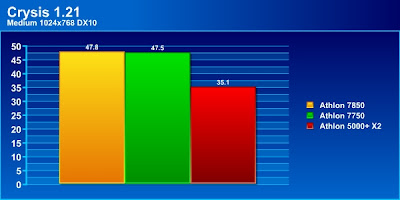
AMD released their Kuma core, basically a dual core Phenom, back in December which performed much better than most expected, competitive with Intel's dual cores for the price. Since then, AMD has been busy with Phenom II launches but in time for AMD's 40th anniversary they've updated the Athlon 7750 Kuma core with the Athlon 7850 Black Edition.
There's not a lot more to say about the 7850 than we did in our 7750 review. As mentioned it is basically a dual core Phenom and in this case featuring an unlocked multiplier. Here's the official technical specs from AMD.
AMD Athlon™ X2 7850 Processor Specifications:
Processor Core Frequency: 2.8GHz
X2 7850 Black Edition Tray OPN: OPN# AD785ZWCJ2BGH
X2 7850 Black Edition PIB OPN: OPN# AD785ZWCGHBOX
L1 Cache Sizes: 64K of L1 instruction and 64K of L1 data cache per core (256KB total L1 per processor)
L2 Cache Sizes: 512KB of L2 data cache per core (1MB total L2 per processor)
L3 Cache Size: 2MB (shared)
Total Cache (L2+L3): 3MB
Memory Controller Type: Integrated 128-bit wide memory controller *
Memory Controller Speed: Up to 1.8GHz with Dual Dynamic Power Management
Types of Memory Supported: Support for unregistered DIMMs up to PC2 8500 (DDR2-1066MHz)
HyperTransport 3.0: One 16-bit/16-bit link @ up to 3.6GHz full duplex (1.8GHz x2)
Total Processor-to-system Bandwidth: Up to 28.5 GB/s bandwidth [Up to 17.1GB/s memory bandwidth (DDR2-1066) + 14.4GB/s (HT3)]
Packaging: Socket AM2+ 940-pin organic micro pin grid array (micro-PGA)
Fab location: GLOBALFOUNDARIES Fab 1 module 1 in Dresden, Germany (formerly AMD Fab 36)
Process Technology: 65-nanometer DSL SOI (silicon-on-insulator) technology
Approximate Transistor count: ~ 450 million (65nm)
Approximate Die Size: 285 mm2 (65nm)
Max Ambient Case Temp: 73o Celsius
Nominal Voltage: 1.2-1.25 Volts
Max TDP: 95 Watts
here is some pictures from amdzone


There's not a lot more to say about the 7850 than we did in our 7750 review. As mentioned it is basically a dual core Phenom and in this case featuring an unlocked multiplier. Here's the official technical specs from AMD.
AMD Athlon™ X2 7850 Processor Specifications:
Processor Core Frequency: 2.8GHz
X2 7850 Black Edition Tray OPN: OPN# AD785ZWCJ2BGH
X2 7850 Black Edition PIB OPN: OPN# AD785ZWCGHBOX
L1 Cache Sizes: 64K of L1 instruction and 64K of L1 data cache per core (256KB total L1 per processor)
L2 Cache Sizes: 512KB of L2 data cache per core (1MB total L2 per processor)
L3 Cache Size: 2MB (shared)
Total Cache (L2+L3): 3MB
Memory Controller Type: Integrated 128-bit wide memory controller *
Memory Controller Speed: Up to 1.8GHz with Dual Dynamic Power Management
Types of Memory Supported: Support for unregistered DIMMs up to PC2 8500 (DDR2-1066MHz)
HyperTransport 3.0: One 16-bit/16-bit link @ up to 3.6GHz full duplex (1.8GHz x2)
Total Processor-to-system Bandwidth: Up to 28.5 GB/s bandwidth [Up to 17.1GB/s memory bandwidth (DDR2-1066) + 14.4GB/s (HT3)]
Packaging: Socket AM2+ 940-pin organic micro pin grid array (micro-PGA)
Fab location: GLOBALFOUNDARIES Fab 1 module 1 in Dresden, Germany (formerly AMD Fab 36)
Process Technology: 65-nanometer DSL SOI (silicon-on-insulator) technology
Approximate Transistor count: ~ 450 million (65nm)
Approximate Die Size: 285 mm2 (65nm)
Max Ambient Case Temp: 73o Celsius
Nominal Voltage: 1.2-1.25 Volts
Max TDP: 95 Watts
here is some pictures from amdzone


Monday, May 04, 2009
AMD Athlon II X3 405e sighted
 I've read the news from hardware info. They was talking about new Athlon II X3 405e.
From the picture it's like the Phenom II family it can be unlocked the fourth core.
Sunday, January 11, 2009
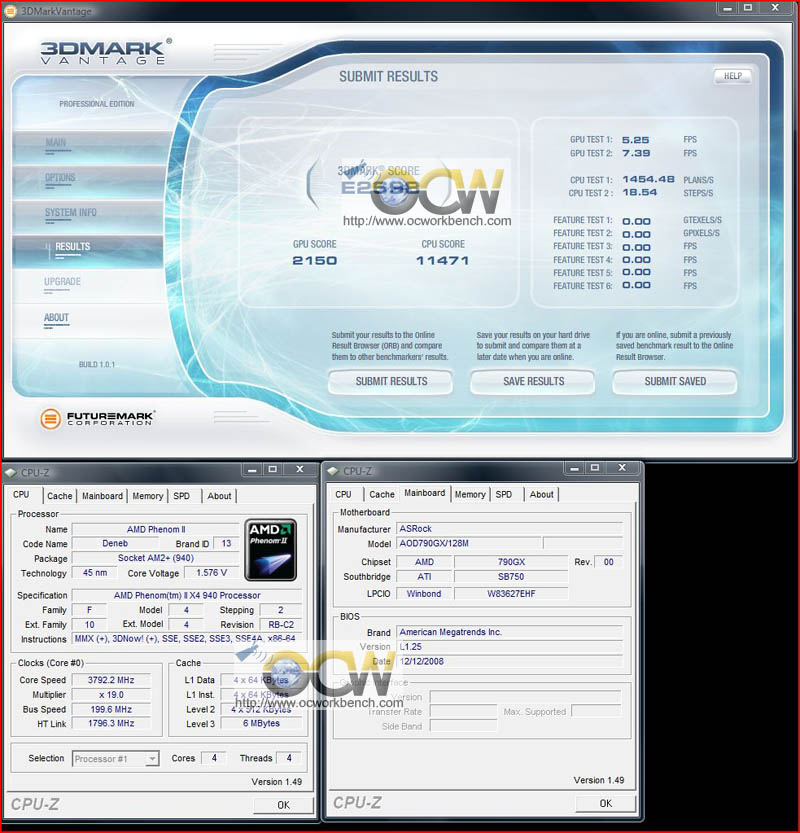
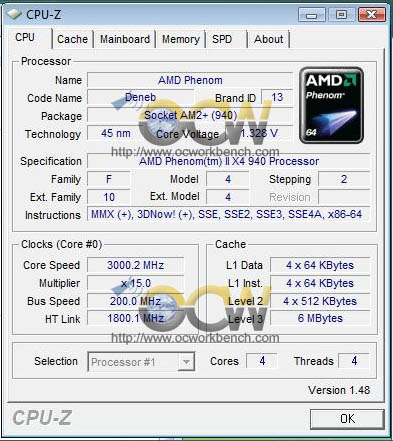
AMD PHENOM II 940 test


 power consumption
| Idle | Load | |
| Phenom II 940 | 118W | 198W |
| Phenom 9950 | 120W | 220W |
price
Phenom II 940 will launch at $275 and the Phenom II 920 $235.
Thursday, December 25, 2008
AMD Bets Big On CPU-GPU Fusion In 2009
ChannelWeb has offered its own series of predictions for 2009, covering everything from chips to networking to storage. But what do the real insiders think is going to happen in the coming year?
We asked three top executives at Advanced Micro Devices to break out the crystal ball and share their prognosticative insights with us. The upshot: Sunnyvale, Calif.-based AMD is betting its unique one-two punch as a leading maker of both x86-based central processors and cutting-edge graphics processors will really start to resonate in the market, that virtualization will go mainstream, and that general-purpose GPU (GPGPU) computing will move sharply away from proprietary interfaces.
Dirk Meyer, president and CEO:
The industry is embarking on the visual computing era, and computing trends in 2009 will amplify the role of graphics in delivering the enhanced experiences users crave. The next wave of industry innovation will come from the fusion of computing and graphics technologies. As the only company in the world shipping both x86-based CPUs and leading-edge graphics, AMD is in a leadership position to deliver the best end-user experiences at home, work or play.
Nigel Dessau, chief marketing officer:
Virtualization will jump the chasm from large enterprise projects to the mainstream. In addition, we should expect customers to demand multiarchitecture or heterogeneous solutions that enable live migrations between PC suppliers, chip and operating system types. This is the year where we will all finally agree: the speed of the processor is no longer the most significant factor in defining the experience of the user.
Rick Bergman, senior vice president and general manager, graphics products group
A transition from proprietary to standard interfaces for GPGPU is ready to occur in 2009, as the first generation of proprietary APIs is quickly replaced by industry standard interfaces such as Havok, OpenCL and the compute shader features of DirectX 11. This will be a natural and much-needed evolution, allowing GPGPU acceleration to fully penetrate mainstream programming environments, and further unlocking the massive floating point computation of GPUs for processing general purpose applications from the desktop to the data center.
History has shown that proprietary programming interfaces are almost always replaced by freely distributed industry standards. This is because industry standards typically encourage greater and more widespread programmer productivity and innovation, while also enabling programmers to address the largest possible hardware installed base.
And with a DirectX 10.1 hardware install base well into the tens of millions, we also expect to see an uptick in games using that API, as more visually complex games and an increasingly competitive game software landscape create the need to unlock advanced AA techniques and additional "free" game performance.
Server Wars: AMD`s Opteron VS. Intel
In the battle for 45 nanometer dual-process supremacy, AMD’s Opteron 2384 is pitted against Intel’s X5492 Xeon. The winner comes down to the classic factors of power consumption vs. performance.
With the launch of “Shanghai”, AMD has revamped their Opteron product line to do battle with Intel’s Xeon in the multi-cpu server space. Does Intel have anything to worry about?
Server CPUs tend to be unique beasts. Sure you can build a server with a desktop CPU, but once you move into the multi-processor space, things begin to change.
Intel has dominated that multi-processor server (and workstation) market with its 45 nanometer Xeon line, especially in the lucrative and large dual processor segment.
Recognizing Intel’s success, AMD recently launched its latest Opteron CPUs, code named Shanghai, to compete with Intel in dual-processor servers.
Intel would win hands down if winning in the dual processor race was based purely on speed. However, there are many more factors to consider when building dual-processor servers, including power usage, performance per watt, heat generated and, of course, price.
In the dual-processor server market, Intel’s 5400 series of Xeon (Harpertown) CPUs seem to be the most popular. Xeon 5400 series processors are available in several different models, ranging from the Quad Core E5405, which runs at 2Ghz and has a thermal design power (TDP) rating of 80 watts, to the X5492, which runs at 3.4Ghz and has a TDP of 150 watts.
AMD offers several models of the Opteron (45nm Shanghai) CPU for dual-processor systems, ranging from the 2376, which has a clock speed of 2.3GHz, to the 2384, which has a clock speed of 2.7GHz. All third generation Opteron (45nm Shanghai) offer a 4x512KB L2 cache, 6 MB L3 Cache and have an average CPU power of 75 watts.
Comparing the best of dual-processor servers meant pitting Intel’s 3.4Ghz X5492 Xeon against the AMD 2.7Ghz Opeteron 2384. For a direct comparison, we turned to the SPECjbb2005 benchmark, which scored the Xeon X5492 at 324,451 and the Opteron 2384 at 311,471–showing that the Intel CPU has a speed advantage, at least when it comes to synthetic testing of elements such as the JVM (Java Virtual Machine), JIT (Just-In-Time) compiler, garbage collection, threads.
AMD’s Opteron 2384 has a average retail price of about $1,050, while Intel’s X5492 Xeon retails for $1,700. That brings up an interesting point, how much Intel processor can $1,050 buy, and how would that compare with the Opteron 2384? The Intel Xeon E5450 sports a price of about a $1,000, and tones the specs down a little bit compared to the X5492. The Xeon E5450 is an 80 watt quad core 3.0Ghz CPU and uses significantly less power than the X5492 (150 watt), which translates to less heat generated and lower electric bills. The E5450 is priced close to the AMD Opteron 2384 and has comparable power ratings (80 watts for the Intel, 75 watts for the AMD).
That said, initial performance comparisons gives the edge to AMD with the Xeon E5450 offering a SPECjbb 2005 rating of
293,213, slightly behind AMD’s 311,471. Simply put the
Opteron 2384 offers about a 6 percent performance increase over the Xeon E5450.
Of course, Specjbb2005 is only one bench mark, when we switched over to PassMark to score the CPUs, we came additional ratings which mirrored the previous tests. PassMark’s Performance Test offers a “CPUMark” rating score, which focuses on testing the CPU performance– here a pair of Intel Xeon E5450 CPUs scored a CPUMark of 9025, while a pair of AMD Opteron 2384 CPUs scored a CPUmark of 9449, roughly a 5.5 percent performance advantage.
So what exactly does all of this mean for the system builder? The quick take is that despite the launch of new processors and changes in technology, little has changed in the market. It all comes down to two elements: speed vs. cost.
For system builders looking for the most bang for the buck, a dual-processor server using AMD’s 45nm Opterons is the way to go. Those looking for max performance, the Intel Xeon proves to be the top dog.
There are some further complications coming down the pike. Intel will be expanding upon the technology that makes it latest “Nehalem” CPUs impressive performers, while AMD is sure to learn a thing or two when their new Phenom II CPUs hit the streets early next year.
With the new Opterons, AMD has proved that it can play “catch-up” with Intel, and still keep the market competitive. Simply put, AMD has put the ball is in Intel’s court for the dual-processor server market. Don’t count Intel out, though, since it’s sure to mount a strong reply to the third-generation Opteron.
Multicore doesn't mean equal core
As anyone who has worked on a group project knows all too well, not all team members contribute equally to the success of a project. And now Virginia Tech researchers have found the same holds true for the cores in multicore processors.
Depending on how your code is distributed across seemingly identical cores, the speed at which that code is executed on a multicore processor can vary by as much as 10 percent.
If you've ever had a program perform slower than expected or perform quickly on one day and not as spritely the next, you might want to examine how that CPU is executing the job.
"The solution to this is to dynamically map processes to the right cores," said Thomas Scogland, a Virginia Tech graduate student who summarized this quirk at the SC08 conference in Austin, Texas, last month. Scogland and fellow researchers, with help from the Energy Department's Argonne National Laboratory, developed prototype software that could one day help balance performance more equally across all cores. DOE also helped fund the work.
In the past few years, Advanced Micro Devices and Intel have developed multicore chips as a way of boosting performance over previous generations of commodity microprocessors. They have moved from two cores to four or even eight cores per chip.
Developers and systems engineers have mostly expected each core in a multicore processor to have the same effective capability. However, that is not necessarily the case for a variety of reasons, Scogland said.
In all fairness, it's not the cores' fault, technically speaking. Although the cores are identical, how a program is distributed among the cores can affect how quickly it runs. And in most cases, the operating system and hardware spread a program across multiple cores rather arbitrarily, which leads to varying performance.
A number of factors contribute to that variance, the researchers said. One factor is how the CPU hardware handles interrupts. In many cases, they could be directed to a single core, which could slow other applications on that core. However, if the interrupts are distributed across all the cores dynamically, there is no guarantee that the core handling the interrupt will be the same one that is running the program for which that interrupt was intended. Therefore, additional communication time is needed between the two cores.
Thursday, December 18, 2008


Wednesday, December 17, 2008
AMD 9950 unpacking
I found it on youtube for someone who wonder is there a heat sink in 9950 black edition.
How ATI stole Christmas
Yesterday we talked about Nvidia's Christmas lineup, bargains, or rather lack of them, here. Today it's ATI's turn, and things are looking good for the Canadian outfit, although considering what it's up against, this is hardly a surprise.
Let's start cheap and work our way up the ladder. At €33+ you can get the HD4350, while HD4550 prices start at €46. Don't let the numbers fool you, both are based on the RV710 core and differ in memory size and type (256 MB DDR2 vs. 512MB DDR3). While we can recommend the HD4350 for undemanding users, or HTPC builders, the HD4550 doesn't look like a good deal. Here's the catch, for just seven euros more you can get the HD4650, an RV730 card with 512MB of DDR2. The DDR3 version of the RV730, branded HD4670, costs €69.
In the same price range you'll find ATI's top value card of yesteryear, the HD3850. The cheapest one comes from MSI, and sells for €56. It's overclocked, but has just 256MB of memory. If you need more, you can get Sapphire's HD3850 with 512MB card for €69. HD3870 cards sell for €87+, and non-reference versions still cost over €100. Nvidia's G92 based 8800/9800GT cards have slipped into this price range, not to mention the HD4830, and both offer better performance. An overclocked dual GPU HD3870 X2 from MSI costs €174. It still packs quite a punch, and the price is reasonable.
So much for the RV670, let's move on to Nvidia's nemesis, ATI's RV770 based cards. The lineup starts with the HD4830, probably the best bang for buck card on the market at the moment. The cheapest ones come from HIS and Sapphire, and sell for €99. In our tests the HD4830 managed to outperform an overclocked 9800GT, not to mention the old HD3870, so even this crippled RV770 card packs quite a punch. As for the HD4850, it currently sells for €122+, a fair price, while the cheapest HD4870 costs €189. The latter seems a bit overpriced, especially following Nvidia's revamp of the GTX260 216 and the launch of new 180 Forceware drivers.
The R700 was never meant to be a budget card, but in recent weeks it's gone up in price, not down. Thank the weak euro and the bankers who led us straight into a recession for that. The cheapest one now costs €418, whereas three months ago it was selling for €30 less. The good news is that someone in ATI finally realized that the HD4850 X2 has potential, and what's more, they also realized that it can't be sold for €350. This, along with the two month delay, was the trouble with this rare card from the start. It was supposed to be a more sensible version of the R700, but it ended up costing almost as much as the regular one. Not anymore. As of today you can get the HD4850 X2 for €271 and it's finally starting to make sense.
ATI truly managed to steal Christmas this year, from the low-end, through the mid-range, all the way to the top, it dominates the market with affordable, yet powerful products. A year ago, Nvidia couldn't even meet demand for its G92 based cards, forcing ATI to fight for scraps, but the tables have turned and we can only hope Nvidia makes a comeback soon
Let's start cheap and work our way up the ladder. At €33+ you can get the HD4350, while HD4550 prices start at €46. Don't let the numbers fool you, both are based on the RV710 core and differ in memory size and type (256 MB DDR2 vs. 512MB DDR3). While we can recommend the HD4350 for undemanding users, or HTPC builders, the HD4550 doesn't look like a good deal. Here's the catch, for just seven euros more you can get the HD4650, an RV730 card with 512MB of DDR2. The DDR3 version of the RV730, branded HD4670, costs €69.
In the same price range you'll find ATI's top value card of yesteryear, the HD3850. The cheapest one comes from MSI, and sells for €56. It's overclocked, but has just 256MB of memory. If you need more, you can get Sapphire's HD3850 with 512MB card for €69. HD3870 cards sell for €87+, and non-reference versions still cost over €100. Nvidia's G92 based 8800/9800GT cards have slipped into this price range, not to mention the HD4830, and both offer better performance. An overclocked dual GPU HD3870 X2 from MSI costs €174. It still packs quite a punch, and the price is reasonable.
So much for the RV670, let's move on to Nvidia's nemesis, ATI's RV770 based cards. The lineup starts with the HD4830, probably the best bang for buck card on the market at the moment. The cheapest ones come from HIS and Sapphire, and sell for €99. In our tests the HD4830 managed to outperform an overclocked 9800GT, not to mention the old HD3870, so even this crippled RV770 card packs quite a punch. As for the HD4850, it currently sells for €122+, a fair price, while the cheapest HD4870 costs €189. The latter seems a bit overpriced, especially following Nvidia's revamp of the GTX260 216 and the launch of new 180 Forceware drivers.
The R700 was never meant to be a budget card, but in recent weeks it's gone up in price, not down. Thank the weak euro and the bankers who led us straight into a recession for that. The cheapest one now costs €418, whereas three months ago it was selling for €30 less. The good news is that someone in ATI finally realized that the HD4850 X2 has potential, and what's more, they also realized that it can't be sold for €350. This, along with the two month delay, was the trouble with this rare card from the start. It was supposed to be a more sensible version of the R700, but it ended up costing almost as much as the regular one. Not anymore. As of today you can get the HD4850 X2 for €271 and it's finally starting to make sense.
ATI truly managed to steal Christmas this year, from the low-end, through the mid-range, all the way to the top, it dominates the market with affordable, yet powerful products. A year ago, Nvidia couldn't even meet demand for its G92 based cards, forcing ATI to fight for scraps, but the tables have turned and we can only hope Nvidia makes a comeback soon
AMD 7000 series
The new CPUs are part of the Athlon X2 product family, but carry a new 7000-series number sequence. The 7750 and 7550 (available to OEMs only) depart from the old 65 nm (K8) Brisbane core and use the “Kuma” core, which is based on the K10 or Stars architecture (the K10 name does not officially exist, according to AMD.) Built in 65 nm, the chips are released more than half a year after their initially planned release and offer clock speeds of 2.5 and 2.7 GHz. Like the preceding Brisbane core, Kuma comes with 128 KB L1 data cache, 128 KB L1 instruction cache and 1 MB L2 cache. However, Kuma adds 2 MB L3 cache – Brisbane CPUs do not integrate L3 cache.
The Athlon X2 7750 is currently listed with a tray-price of $79, just above the $76 the company charges for its Athlon X2 6000. With a quick look over to Intel, the same $79 would not be enough to buy you a Core 2 Duo-class processor. Intel currently sells the Pentium Dual-Core E2220 (2.4 GHz, 65 nm) for $74 and the E5200 (2.5 GHz, 45 nm) for $84. The cheapest Core 2 Duo, the E7200, lists for $113.
The Athlon X2 7750 is currently listed with a tray-price of $79, just above the $76 the company charges for its Athlon X2 6000. With a quick look over to Intel, the same $79 would not be enough to buy you a Core 2 Duo-class processor. Intel currently sells the Pentium Dual-Core E2220 (2.4 GHz, 65 nm) for $74 and the E5200 (2.5 GHz, 45 nm) for $84. The cheapest Core 2 Duo, the E7200, lists for $113.
Tuesday, December 02, 2008
AMD Phenom II listings begin to appear, priced at sub-£200
Today, a pair of those Phenom II processors have appeared on the pages of UK-based etailer MoreComputers.com. According to its product listings, Phenom II will arrive in two models - a 2.8GHz Phenom II 920 and a 3.0GHz Phenom II 940 Black Edition, priced at £190.65 and £231.32, respectively.
The 920 and 940 nomenclature may seem strangely familiar, but the quad-core Phenom II won't be challenging Intel's Core i7 in the performance stakes, we feel. Instead, it'll attempt to put AMD back in the desktop race with a set of affordable mid-range chips that should at the very least challenge Intel's ageing Core 2 range.
There may still be no win in sight for AMD, though. Should Phenom II pose a threat, we'd expect Intel to respond with a slight swipe at its Core 2 pricing. Either way, the competition should result in well-priced mid-range processors for the masses.
Readers should also be aware that MoreComputers' prices are anything but definitive, and that the etailer doesn't offer any pre-sales or post-sales technical support whatsoever. Although the listings appear to be about right in our estimation, official pricing and availability won't be known until AMD lets it slip.
Source : www.hexus.net
Subscribe to:
Posts (Atom)